🔬 Advancing Photovoltaic Innovation within LEEMONS
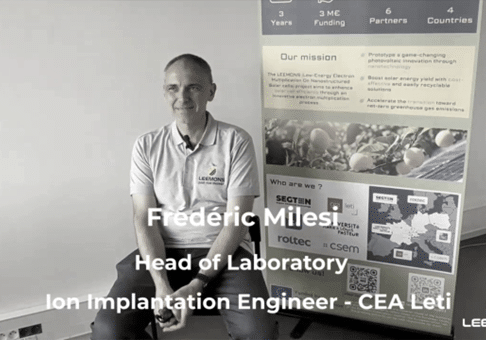
In this interview, Bertrand Paviet Salomon shares his role within the LEEMONS project and explains how his expertise contributes to advancing next-generation photovoltaic technologies.
As part of the LEEMONS consortium, his work supports the development and validation of innovative approaches designed to enhance silicon solar cell performance through low-energy electron multiplication.
▶️ Watch the Interview – Bertrand Paviet Salomon
⚙️ Role within the LEEMONS Project
During the interview, Bertrand Paviet Salomon discusses:
- His technical background and expertise
- His contribution to the project’s objectives
- The challenges associated with implementing innovative photovoltaic processes
- The importance of collaboration within a European research consortium
His work contributes to strengthening the scientific and technological foundations of LEEMONS, ensuring that the project moves toward scalable and industrially compatible solutions.
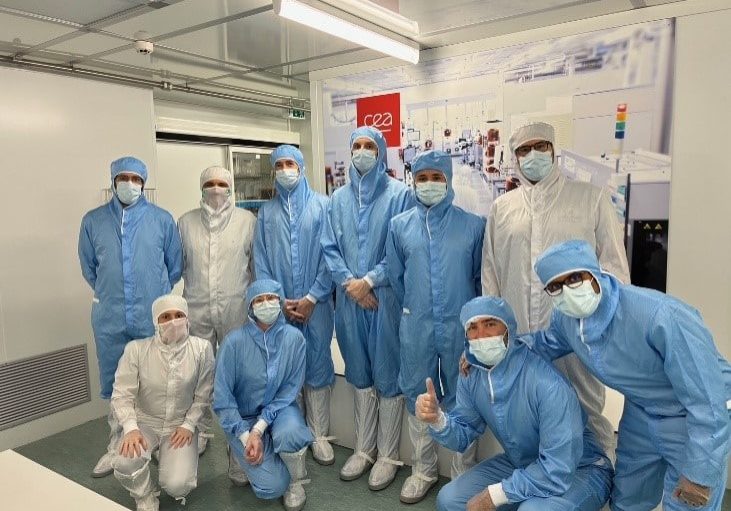
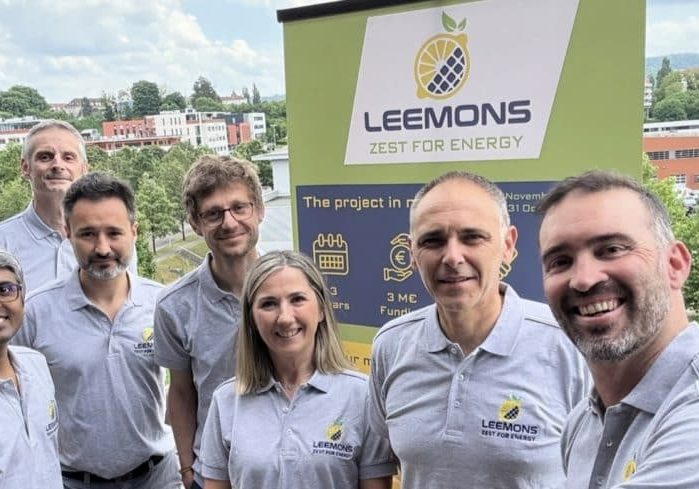
🤝 Working in a European Consortium
The LEEMONS project brings together:
- Research institutes
- Universities
- Industrial partners
- SMEs and start-ups
This multidisciplinary collaboration allows knowledge exchange between different technological domains and accelerates innovation.
The interview highlights how cooperation between partners is essential to address technical challenges and achieve project milestones.
🚀 Toward Higher-Efficiency Silicon Solar Cells
LEEMONS aims to demonstrate a breakthrough approach capable of reducing thermalisation losses in silicon solar cells, potentially opening new pathways toward higher efficiency levels compatible with existing industrial manufacturing lines.
The contribution of experts like Bertrand Paviet Salomon is essential in bridging research, development and industrial feasibility.
🌍 About LEEMONS
LEEMONS (Low-Energy Electron Multiplication On Nanostructured Solar Cells) is a Horizon Europe project funded by the European Union under Grant Agreement No. 101172870.
The project aims to demonstrate an innovative electron multiplication phenomenon capable of overcoming thermalisation losses in silicon solar cells while remaining compatible with 80–95% of existing photovoltaic manufacturing lines.
🇪🇺 Funding Acknowledgement
Funded by the European Union. Views and opinions expressed are however those of the author(s) only and do not necessarily reflect those of the European Union or CINEA. Neither the European Union nor the granting authority can be held responsible for them.